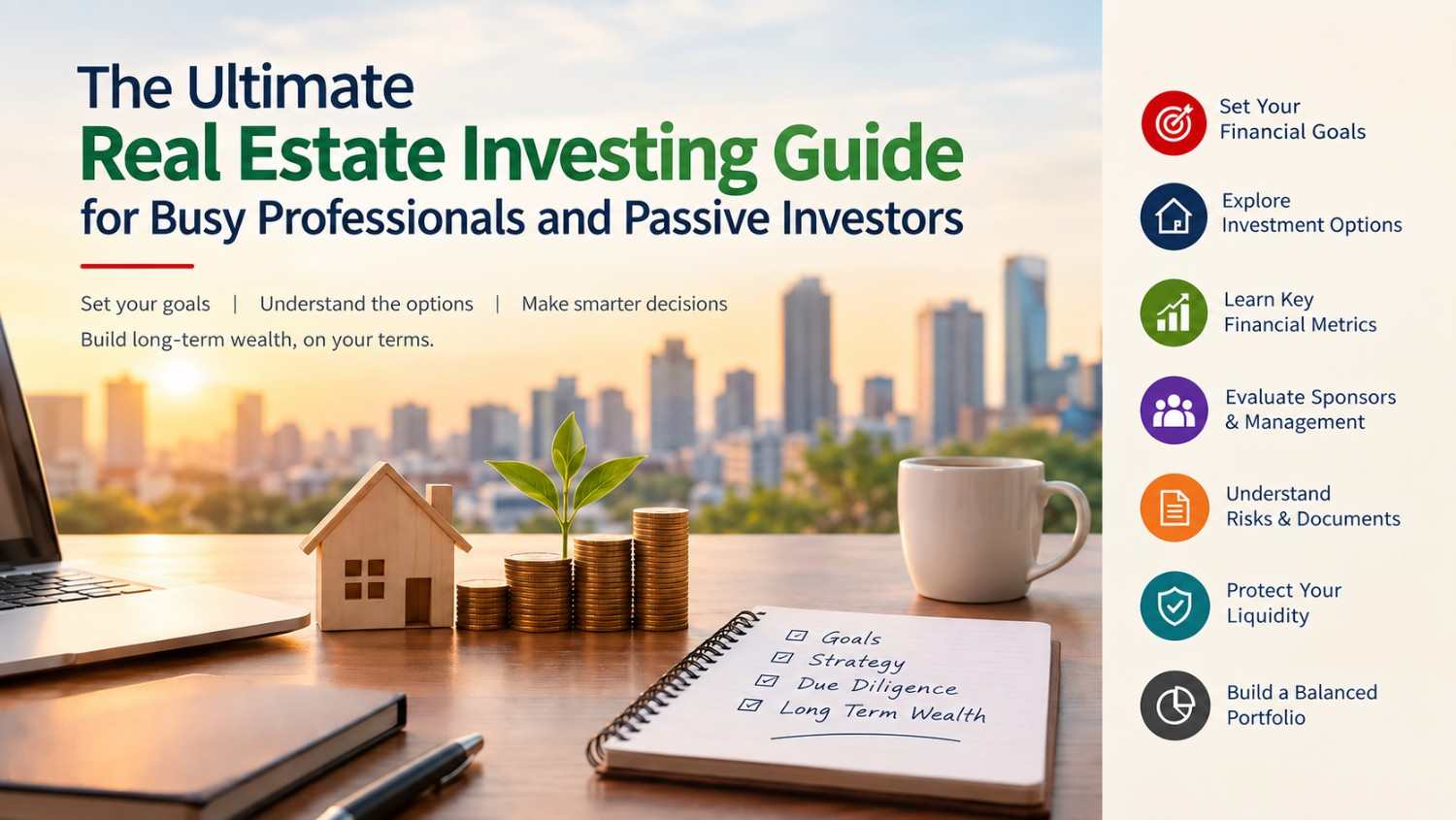

Most busy passive investors do not have the time or desire to become full time real estate operators. They have careers, Businesses, Families, Other responsibilities competing for their attention. But many still want to understand whether real estate can have a place in their long term financial strategy.
That is where passive real estate investing often enters the conversation. The challenge is knowing where to begin. There are properties, funds, syndications, REITs, sponsors, cap rates, cash flow projections, debt structures, tax considerations, and pages of investment documents. It can quickly feel like another full time job. It does not have to.
A good real estate investing guide for busy passive investors, should help you understand the few things that matter most so you can ask better questions and make more informed decisions.
Here is where I would start.
Before looking at a property, start with yourself.
These questions sound simple, but they can save you from looking at investments that were never right for you in the first place. A real estate investment should fit your financial life. Your financial life should not have to adjust itself around every investment opportunity that comes your way.
There is a big difference between owning real estate and operating real estate. An active investor may find the property, arrange financing, negotiate contracts, oversee renovations, manage tenants, supervise property managers, review budgets, solve operating problems, and eventually handle a sale or refinancing.
That takes time, It also takes experience. Passive real estate investing is different. A passive investor generally contributes capital while another person or company manages the investment and executes the business plan. That can be appealing for busy investors who want real estate exposure without taking on the day to day work of operating properties.
But passive does not mean hands-off when it comes to due diligence. A real estate investing guide for busy passive investors should help you understand the investment before committing your capital. Someone else may manage the property, but you still need to understand how the investment works, the potential risks, and the key factors that could affect your returns.
There is more than one way to build real estate exposure, Like:
Each works differently. Direct ownership gives you more control, but it may also require more time, capital, and management responsibility. Private investments may allow you to participate more passively, but they can involve limited liquidity and may require your capital to remain invested for years.
Publicly traded REITs generally provide easier liquidity, but their share prices can move with public markets. There is no single option that is automatically better. The right question is which structure fits what you are trying to accomplish.
You do not need to become an accountant to invest in real estate. But you should understand what the basic numbers mean.
Net operating income, commonly called NOI, represents the income a property generates after qualifying operating expenses are deducted, before certain items such as debt service.
If a property generates $1 million in operating revenue and has $400,000 in qualifying operating expenses, the NOI would be approximately $600,000.
Understanding NOI helps you see what the property itself is producing before financing is considered.
A cap rate compares a property’s net operating income with its value or purchase price. It is useful when comparing properties, but it should never be used alone.
A higher cap rate may reflect higher perceived risk. A lower cap rate may reflect a stronger location, newer property, stronger tenants, or different expectations.
Cash flow is what many passive investors focus on first. But instead of asking only how much cash flow is projected, ask where it comes from.
Understanding the assumptions is more important than memorizing the projected percentage.
If you are investing passively, someone else is making decisions with your capital. That deserves serious attention.
Anyone can explain a successful investment. You often learn more about people by asking how they behaved when things did not go according to plan.
This is one area busy investors should never overlook. Real estate is often purchased with debt. The way that debt is structured can have a major impact on the investment.
Ask:
A good property can still face serious pressure if the financing is poorly structured. Do not just evaluate the building. Evaluate how the building is being financed.
A good spreadsheet cannot fix a weak market. Before investing, understand where the property is located and what is driving demand.
For commercial properties, also understand who actually uses the building.
(You can check our blog regarding: Commercial Real Estate Investing for Beginners)
Real estate is local. A strong national story does not automatically make an individual property a strong investment.
Also Refer this blog: Commercial Real Estate Investment Insights 2026
One of the biggest differences between private real estate and investments traded on public markets is liquidity. Many private real estate investments cannot simply be sold whenever you want your money back. Your capital may remain invested for years.
The SEC specifically warns that private placements can involve limited liquidity and the possibility of losing the entire investment.
That is why I believe one of the most important questions for a passive investor is:
When might I need this money again?
Do not invest capital you may need for your business, family obligations, emergencies, taxes, or other near term financial needs. The expected holding period matters. Your personal liquidity matters even more.
Investors naturally want to know what an investment could earn. But I would reverse the order. First ask what could go wrong.
Once you understand those risks, then look at the potential return. A projected return is an estimate. It is not a promise. That distinction should always remain clear.
Busy investors sometimes want to skip this part. Do not. If you are considering a private real estate investment, take the time to review the actual offering and governing documents.
Depending on the structure, that may include a private placement memorandum, operating agreement, subscription agreement, risk disclosures, financial information, fee disclosures, and other documents.
If something is unclear, ask. If something still does not make sense, speak with your own attorney, tax professional, financial advisor, or another qualified professional before investing.
This deserves its own discussion. Real estate investments can include different fees depending on how they are structured.
Or participation in investment profits. Fees themselves do not tell you whether an investment is good or bad. Transparency matters. You should understand what the sponsor earns, when it gets paid, and how the economic structure aligns the interests of the sponsor and investors. If you cannot clearly explain how everyone gets paid, you probably need to ask more questions.
Real estate can have tax considerations that may be meaningful for certain investors. Depreciation is one of the reasons real estate receives attention. But tax treatment can vary considerably depending on the investor, property, structure, income, holding period, and other circumstances. Tax rules can also change.
That is why I would never choose an investment simply because someone describes it as tax advantaged. First determine whether the investment itself makes sense. Then work with your own qualified tax advisor to understand how the tax treatment may apply to you. The investment should make sense before the tax discussion begins.
A real estate investment does not exist in isolation. Look at everything you already own.
Diversification does not eliminate risk. But understanding concentration can help prevent you from unknowingly depending on the same outcome across several investments. The goal is not simply to own more. It is to understand what role each investment plays.
Busy investors do not need to spend their entire week analyzing deals. Create a repeatable process. Before spending serious time on an opportunity, ask a few basic questions.
If you cannot answer those questions, do not rush to the next stage. The purpose of a filter is not to find reasons to invest. It is to quickly identify what deserves deeper due diligence.
Good investing requires patience. An investment may have a deadline.
There will always be another investment. Your capital deserves thoughtful decisions.
Education should not teach you to depend on someone else’s opinion. It should help you develop your own questions. The more you understand about real estate, the easier it becomes to separate an attractive presentation from a thoughtful investment.
You start looking differently at the property, Like:
That is when education begins to become useful.
For busy passive investors, real estate investing does not need to mean becoming a full time operator. But it does require becoming an informed investor. Start with your goals, Understand the investment structure, Learn the basic numbers, Evaluate the sponsor, Study the debt, Understand the market, Protect your liquidity, Read the documents and Know the risks. Then decide whether the investment fits your broader financial life.
A good real estate investing guide for busy passive investors should not tell you what to buy. It should teach you how to think before you buy anything. That is where I would begin.
And ask what happens if the future looks slightly different from the spreadsheet. Markets will always change. Good investing starts with understanding what you own and why you own it.
Read 10 Lessons Every Investor Can Learn from Top Real Estate Investing Podcasts Blog
Passive real estate investing allows investors to contribute capital while another person or company manages the property and investment operations.
Yes, it can provide real estate exposure without requiring investors to manage properties and daily operations themselves.
Investors should evaluate their goals, the sponsor, property performance, debt structure, risks, liquidity, fees, and investment documents.
Net Operating Income (NOI) is the income a property generates after qualifying operating expenses are deducted and before certain items such as debt service.
Why is liquidity important in passive real estate investing?
The sponsor is important because they typically make key decisions about managing the property, finances, operations, and investment strategy.
Investors should understand the potential risks and assumptions first before evaluating the projected returns of an investment.
Your next chapter does not begin with everything figured out. It begins with awareness and one intentional yes.
Disclaimer
This content is for educational and informational purposes only and does not constitute investment, legal, tax, or financial advice. Real estate investing involves risk, including the potential loss of principal. Outcomes are not guaranteed and depend on market conditions, property performance, and economic factors. Past performance is not indicative of future results. Readers should conduct their own due diligence and consult qualified professionals before making investment decisions.