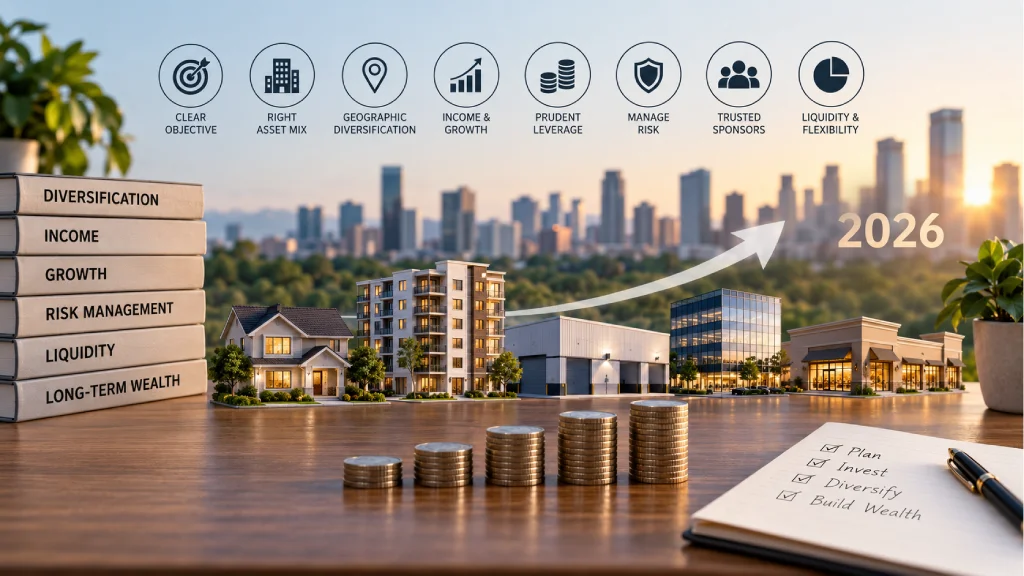


Commercial real estate feels different today than it did a few years ago. Transactions are picking up again. Buyers and sellers are finding more common ground. Some property sectors are showing real improvement. At the same time, financing is still expensive enough that investors cannot afford to be casual about debt, cash flow, or assumptions.
That is why the most useful commercial real estate investment insights are not predictions about where the market will be six months from now. They are signals that help us ask better questions today.
As of midyear 2026, CBRE expects U.S. commercial real estate investment activity to increase approximately 16 percent from the prior year, while cap rates are expected to remain largely stable through the rest of 2026. That tells me something important. Capital is coming back into the market, but investors still need to be selective.
Here are the trends I would be watching.
One of the clearest changes in 2026 is that more commercial real estate is trading. JLL reported approximately $113 billion of U.S. commercial real estate transactions during the first quarter of 2026, a 25 percent increase from the same period in 2025.
That is encouraging. But higher transaction volume does not mean every property suddenly makes sense. For several years, buyers and sellers struggled to agree on value. Higher interest rates changed financing costs and put pressure on property valuations. More transactions can help improve price discovery. For investors, that gives us more information.
Those numbers matter more than asking whether commercial real estate is simply “up” or “down.”
This may be one of the most important commercial real estate investment insights for 2026. CBRE now expects cap rates to remain largely stable through the remainder of the year and says income is likely to be the primary driver of total returns in the current higher rate environment.
That changes how I would look at a deal. If the investment only works because the property must sell at a significantly higher valuation several years from now, I would want to understand that assumption very carefully.
Appreciation can happen. It should not be treated as a guarantee.
A strong investment should have an economic story that makes sense before we start assuming a future buyer will pay substantially more for it.
Interest rates have come down from their recent peaks, but money is not cheap. As of August 14, 2026, the effective federal funds rate was 3.63 percent and the 10 year Treasury yield was 4.68 percent. For commercial real estate investors, the exact rate on a loan will depend on the property, lender, leverage, borrower, term, and many other factors. The larger point is that debt structure still matters tremendously.
When reviewing an investment, I would want to know:
A good property with the wrong debt can still become a difficult investment. Never separate the property from its capital structure.
For the last several years, it has been easy to say, “Office is struggling.” That is too broad. The 2026 picture is becoming much more interesting.
CBRE reports that office fundamentals are continuing to normalize, while JLL says U.S. office leasing helped global leasing reach a new post pandemic high during the first half of 2026. New office supply is also falling sharply.
But that does not mean every office building is recovering equally. The difference between a high quality building in a strong location and an older property with significant vacancies can be enormous.
So instead of asking: “Is office a good investment?”
I would ask:
The asset class label tells you very little without understanding the actual property.
Industrial real estate continues to attract attention. CBRE expects U.S. industrial leasing activity to reach approximately one billion square feet in 2026, supported in part by manufacturing activity, logistics demand, and tenants seeking more functional properties. That is meaningful demand.
Still, I would not translate strong sector numbers into a reason to buy any warehouse.
Real estate is always local. A national trend can help identify where to look. It cannot replace property level due diligence.
Retail is another good example of why investors should be careful about old assumptions. For years, the story around retail was dominated by ecommerce and store closures. The current picture is more nuanced.
JLL reported U.S. retail vacancy at approximately 4.4 percent in the first quarter of 2026, with very limited new supply helping support existing properties. Grocery, restaurant, and discount retailers have remained active in expansion. That does not make retail automatically attractive. It means investors should look deeper.
A neighborhood center serving everyday needs can behave very differently from another type of retail property.
Again, details matter.
I continue to believe housing fundamentals deserve attention, but multifamily investors should not look at national headlines and assume every market behaves the same way. CBRE’s midyear outlook points to improving multifamily conditions during the second half of 2026.
But individual markets can have very different levels of new apartment supply, rent growth, employment growth, insurance costs, property taxes, and affordability. If I were evaluating a multifamily investment today, I would want to understand how much new supply is coming within the immediate area. Not just this year.
The market matters. The submarket matters even more.
There has been tremendous attention around data centers because of artificial intelligence, cloud computing, and growing demand for digital infrastructure.
CBRE reports that demand remains exceptionally strong and expects preleasing of data centers under construction to reach approximately 80 percent. It is an important trend. It is also a good reminder that a fast growing sector is not automatically a simple investment.
Whenever a sector becomes extremely popular, I become even more interested in the price being paid to participate in that growth.
A great industry can still produce a poor investment if the entry price or assumptions do not make sense.
One of the recurring themes I see across commercial real estate today is that broad labels are becoming less useful. Multifamily is not one market. Office is not one market. Industrial is not one market. Even two properties in the same city can have completely different economics.
JLL reported significant differences in investment growth among U.S. cities during the first quarter of 2026, reinforcing how uneven real estate recovery can be from one market to another. That is why I would spend more time understanding the local economy.
A market name alone should never be the investment thesis.
Perhaps my biggest takeaway from the current market is this:
This is where I believe some of the best commercial real estate investment insights come from. Not from asking how much money we can make if everything goes right. From understanding what happens when it does not.
I would keep my eye on a few things, which is listed below:
There will always be another headline. The challenge is knowing which information actually affects the investment you own or are considering.
Commercial real estate appears to be moving into a healthier transaction environment in 2026, with investment activity rising even while financing and economic uncertainty remain part of the picture. I see that as a reason to pay closer attention, not a reason to become less disciplined.
Do not chase a property type simply because it is popular. Do not reject an entire asset class because the headlines are negative.
And ask what happens if the future looks slightly different from the spreadsheet. Markets will always change. Good investing starts with understanding what you own and why you own it.
Your next chapter does not begin with everything figured out. It begins with awareness and one intentional yes.
Disclaimer
This content is for educational and informational purposes only and does not constitute investment, legal, tax, or financial advice. Real estate investing involves risk, including the potential loss of principal. Outcomes are not guaranteed and depend on market conditions, property performance, and economic factors. Past performance is not indicative of future results. Readers should conduct their own due diligence and consult qualified professionals before making investment decisions.