

One of the best things a new investor can learn is not how to find more investments. It is how to ask better questions. A property can look beautiful. A presentation can look impressive. The projected numbers can look attractive. But none of those things tell you whether an investment is right for you. The right real estate investment questions help you look beyond the presentation and understand the property, the people, the financing, the assumptions, and the risks behind it.
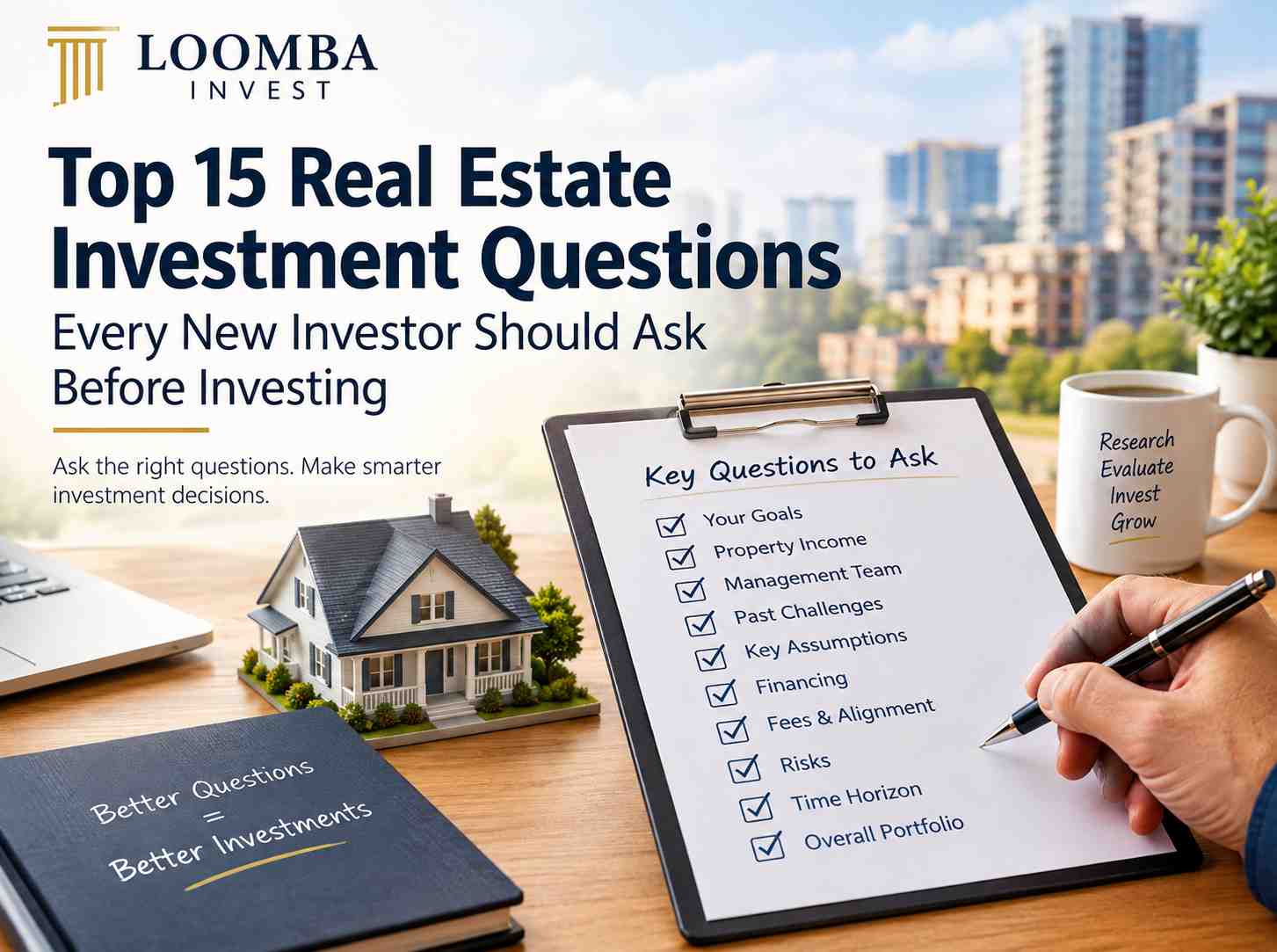
You do not need to know everything about real estate before you invest. But you should know enough to understand what you are putting your money into. Here are fifteen questions I would ask before making a real estate investment.
Start with yourself before you start with the deal.
An investment can be perfectly reasonable for one person and completely wrong for another. Before asking whether it is a good investment, ask whether it is a good investment for you.
This sounds basic, but it is one of the most important real estate investment questions you can ask.
If you cannot clearly explain how the property generates income, keep learning before you invest.
When you invest passively, another person or team may be making important decisions with your capital. Understand who they are.
You are not simply investing in real estate. You are also trusting people to execute a business plan.
I like this question much more than simply asking about the best deal someone has completed.
Almost anyone can talk about a success.
Ask what happened when an investment did not perform as expected.
You can learn a great deal about an investment company or sponsor by understanding how they behave when things become difficult.
Every real estate projection is built on assumptions. Like,
Ask which assumptions have the greatest impact on the projected results. Then ask whether those assumptions seem reasonable. If the investment only works when rents rise quickly, expenses stay low, renovations finish exactly on schedule, and the property sells at an attractive valuation, you should understand how much depends on everything going according to plan. Projections are estimates. They are not guarantees.
Do not look only at the property. Look at the debt. Ask whether the loan has a fixed or variable interest rate.
Debt can have a significant impact on investment results. A strong property with poorly structured financing can still become a difficult investment.
Understand the fee structure before investing. Depending on the investment, there may be acquisition fees, asset management fees, property management fees, construction management fees, financing fees, disposition fees, or participation in investment profits. Fees are not automatically a problem.
The issue is whether you understand them. Ask when each fee is paid. Ask what services are provided in exchange for it. Ask how the sponsor participates when the investment performs well. You should be able to understand how the sponsor and investors each make money.
I like to understand whether the people operating the investment have their own money invested alongside investors. That does not guarantee a successful outcome. But it can help you understand economic alignment. Ask how much of the sponsor’s own capital is invested.
Then look at the entire compensation structure. Alignment is broader than one number. The goal is to understand whether everyone benefits from creating a healthy investment rather than simply completing a transaction.
Private real estate investments can require investors to commit capital for several years, and liquidity may be limited. The SEC specifically cautions investors that private placements may be difficult to sell and can involve loss of the entire investment.
Ask about the expected holding period. Then ask what happens if the property needs to be held longer.
Do not assume your capital will be available simply because you need it. Before investing, make sure the expected time horizon fits your own financial life.
If an investment expects to make distributions, understand what supports them.
Do not look only at the amount of projected cash flow. Understand the source. Cash deposited into your account tells you what was distributed. It does not necessarily tell you what is happening inside the investment.
Do not invest simply because you have heard that a city is growing. Go deeper, Example:
A strong market can help an investment. But a market name alone is never an investment thesis.
Ask this directly.
What are the three biggest things that could cause this investment not to perform as expected?
Listen carefully to the answer. Every real estate investment has risk.
The answer should not be that there is very little risk. A thoughtful operator should be able to explain both the opportunity and the risk.
Real estate does not always follow the spreadsheet. Renovations can take longer. Leasing can take longer. A property may take more time to stabilize. A sale may not happen when originally planned.
Ask what happens in those situations.
One of the best real estate investment questions is simply:
What happens if this takes another year?
The answer can reveal a lot about the strength of the business plan.
Do not make an investment decision based only on a webinar, conversation, summary, or presentation. Read the actual documents provided for the investment.
For a private offering, that may include offering documents, an operating agreement, subscription documents, risk disclosures, fee information, financial information, and other materials depending on the structure.
If you do not understand something, ask. And when appropriate, have your own qualified legal, tax, or financial professionals review the investment with you.
Finally, look beyond this one opportunity.
The question is not simply whether you like the investment. It is what adding the investment does to your overall financial picture.
Sometimes the best decision is to invest. Sometimes the best decision is to pass. Both can be good decisions when they are made thoughtfully.
After reviewing everything, I would ask one final question:
What am I missing?
It sounds simple. But it forces you to stop looking for reasons to say yes and start looking at the investment from another direction.
Good due diligence is not about proving that an investment will work. It is about understanding enough to make an informed decision.
New investors sometimes feel they need to know all the answers. You do not. You need to know which questions to ask.
The best real estate investment questions do not make investing more complicated. They make your decisions clearer. Never be uncomfortable asking questions when your capital is involved. A thoughtful investment decision should be able to withstand thoughtful questions.
Your next chapter does not begin with everything figured out. It begins with awareness and one intentional yes.
Disclaimer
This content is for educational and informational purposes only and does not constitute investment, legal, tax, or financial advice. Real estate investing involves risk, including the potential loss of principal. Outcomes are not guaranteed and depend on market conditions, property performance, and economic factors. Past performance is not indicative of future results. Readers should conduct their own due diligence and consult qualified professionals before making investment decisions.